Stevia FAQs
Some of this is excerpted fromStevia Rebaudiana: Nature's Sweet Secret by David Richard
(Vital Health Publishing)
What is Stevia?
Stevia Rebaudiana is an herb in the Chrysanthemum family which grows wild as a small shrub in parts of Paraguay and Brazil. The glycosides in its leaves, including up to 10% Stevioside, account for its incredible sweetness, making it unique among the nearly 300 species of Stevia plants.
There are indications that Stevia (or Ca-he-he) has been used to sweeten a native beverage called mate since Pre-Columbian times. However, a Natural Scientist names Antonio Bertoni first recorded its usage by native tribes in 1887.
How much Stevia is used around the world?
Exact numbers are unavailable at this time, although it is generally recognised that Stevia is the new and exciting sweetener of the future and many manufacturers are looking at using it in their products as well as a substantial increase in consumer usage in recent years. However, as an indication, Japanese consumers used the equivalent of 700 metric tonnes of Stevia leaves in 1987 alone. This number does not include other major consuming countries such as Brazil and the whole of South America; South Korea, China and the whole of the Pacific Rim; as well as Europe, Australia and North America.
Where is Stevia cultivated?
Mainly in Paraguay, Brazil, Japan and China. There are other growers scattered across the Pacific Rim. Stevia is also being cultivated in Southern Ontario and Mexico. Surprisingly, it has been successfully grown in California and the South of England as well.
How is Stevia Made?
Please see the enclosed document from the Global Stevia Institute here.
How has Stevia been used in food applications?
First, as a prepackaged replacement for sugar and artificial sweeteners. Second, it has been used in various food products, including the Japanese sugar-free versions of Wrigley's gums, Beatrice Foods yogurts and even diet Coke. It has also been used in Japanese style pickles, dried seafoods, fish and meat products, vegetables and seafoods boiled down with soy sauce, confectioneries and a host of other products. In 2008, Food Standards Australia & New Zealand approved Stevia as a food ingredient (it was previously classified as a dietary supplement), and many food manufacturers are now using Stevia in a variety of foods and dietary drinks.
Is Stevia safe?
In general, Stevia is an all-natural herbal product with centuries of safe usage by native Indians in Paraguay. It has been thoroughly tested in dozens of tests around the world and found to be completely non-toxic. It has also been consumed safely in massive quantities (Thousands of tonnes annually) for the past twenty years.The approval by FSANZ was based on an extensive analysis of the safety of the product.
Can Stevia replace sugar in the diet?
Yes. Refined sugar is virtually devoid of nutritional benefits and, at best, represents empty calories in the diet. At worst, it has been implicated in numerous degenerative diseases. Stevia is much sweeter than sugar and has none of sugar's unhealthy drawbacks.
How sweet is Stevia?
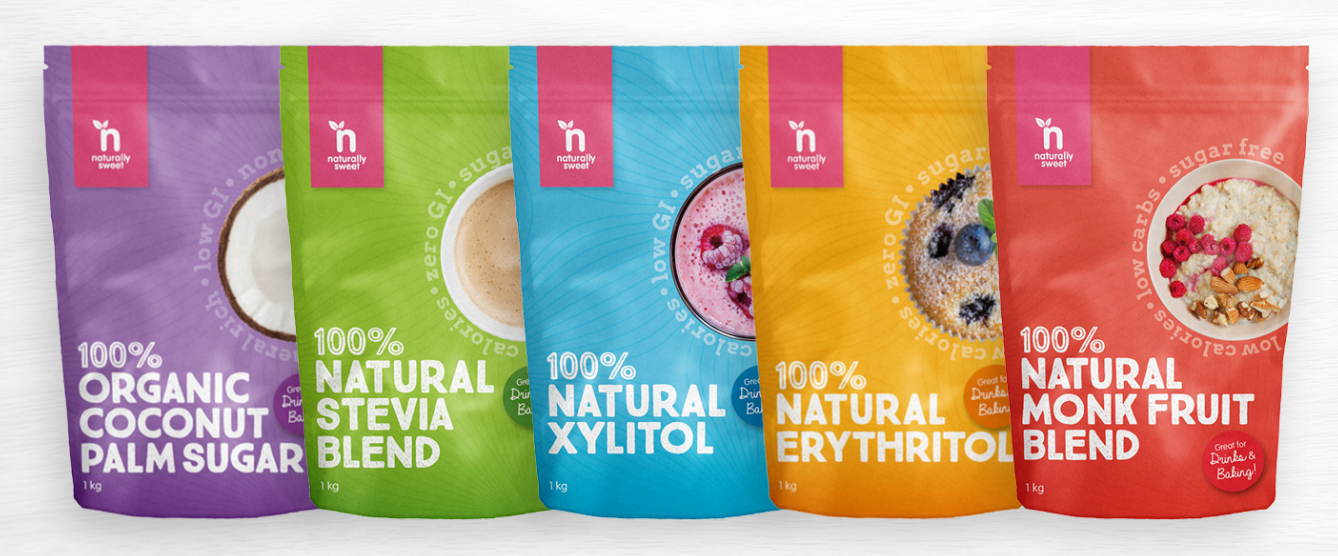
The crude Stevia leaves and herbal powder (green) are 10-15 times sweeter than table sugar. The refined extracts of Stevia called steviosides (a white powder, 85-95% Steviosides) are 200-300 times sweeter than table sugar. Experience is that the herbal powder is very sweet while the refined extract is incredibly sweet and needs to be diluted to be properly used. Both products have a slightly bitter aftertaste, also characteristic of licorice, unless they are modified with an excipient (such as Erythritol in Naturally Sweet Stevia Blend).
How many calories in Stevia?
Virtually none. Stevia in its raw form is zero calories but the added excipients (for improved taste) add some very small amounts (the Naturally Sweet Stevia is 0.2 cals/g).
Will Stevia raise my blood sugar levels?
Not at all. In fact, according to some research, it may actually lower blood sugar levels. However, this research has yet to be confirmed and contradictory results make any conclusions premature.
Can I use Stevia if I am a diabetic?
Diabetes is a medical condition which should be monitored and treated by a qualified physician or health care practitioner. However, Stevia can be a part of a healthy diet for anyone with blood sugar problems since it does not raise blood sugar levels. If in doubt, ask your doctor. However, if they do say no, ask them politely for the current research to support their opinion.
Does Stevia taste like sugar?
Stevia does not taste exactly like sugar but, like everything else, it takes time to adjust our senses to new things. If you try it a few times you will notice that your taste buds become accustomed to the new taste (Psychologists say it takes 21 days to completely adjust to new conditions, regardless of the type), so stick with it as it will be worth it!